PB Vision Skill Ratings
Learn how PB Vision generates per-game, profile, and component skill ratings from processed doubles games, and how those ratings differ from DUPR.
PB Vision and DUPR measure different things. PB Vision evaluates performance within each eligible processed doubles game. DUPR is based on match results. Because the systems measure different signals, their ratings can differ.
You can link your DUPR account in PB Vision account settings and submit an eligible game below the video. If you do not already have a DUPR rating, the submission will generate an initial AI-assisted DUPR rating. If you already have a DUPR rating, the submission is informational and does not change your existing DUPR rating today. Each player must submit individually from their own linked account for the game to count toward their DUPR profile.
👀 What Is A PB Vision Skill Rating?
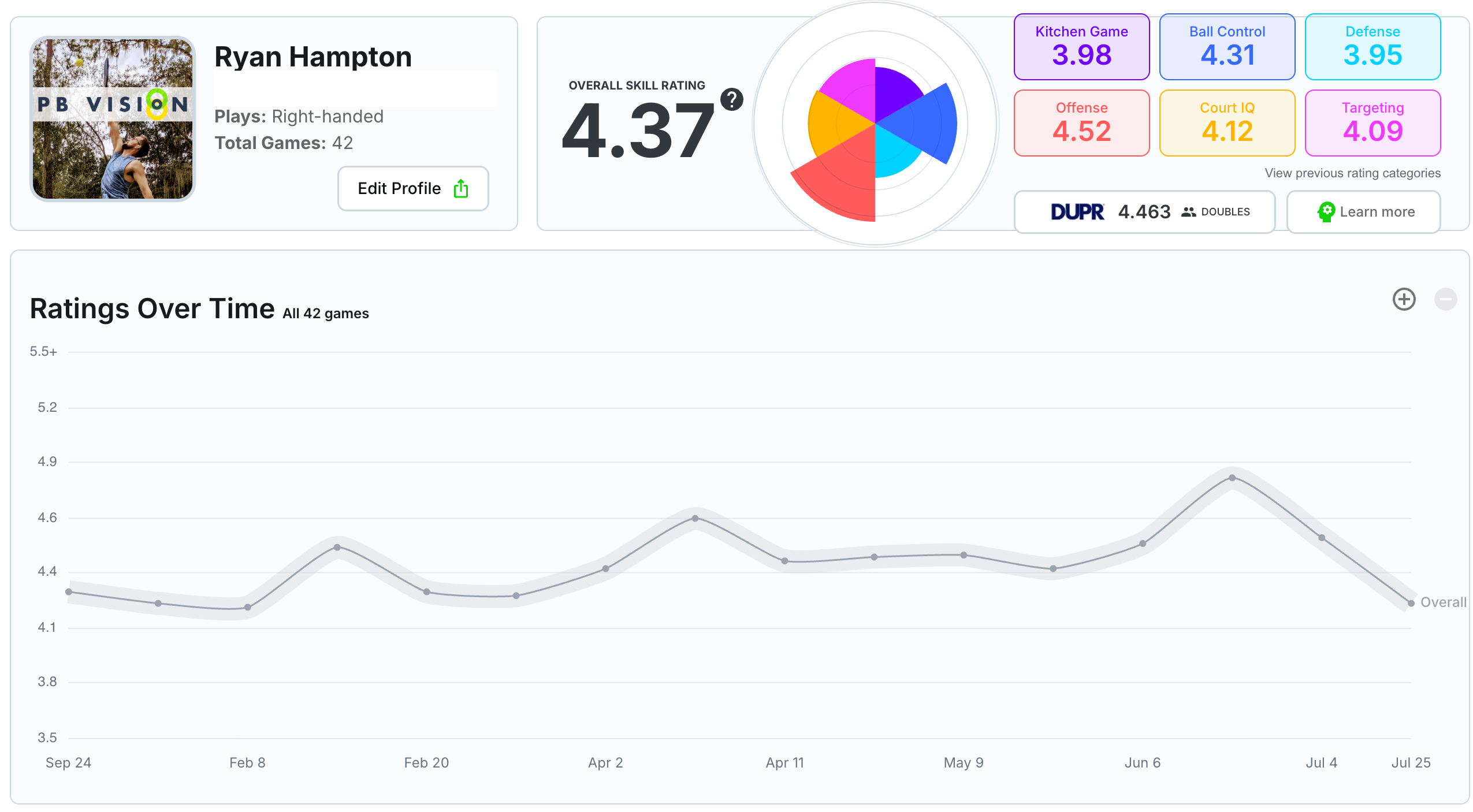
PB Vision analyzes each eligible processed doubles game in which you’re tagged. It generates a per-game rating from performance signals such as movement, positioning, shot execution, errors, and rally outcomes. The rating focuses on how you performed in that match, not only on whether you won.
PB Vision ratings use a 2.0–8.0 scale and currently cap at 5.5, the upper limit the model can assess reliably today. Your overall rating is not a simple average of the six component ratings.
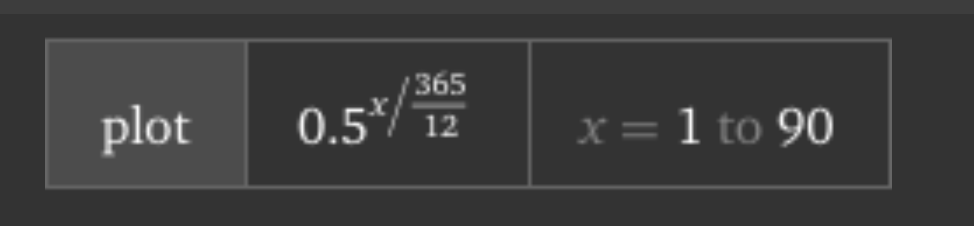
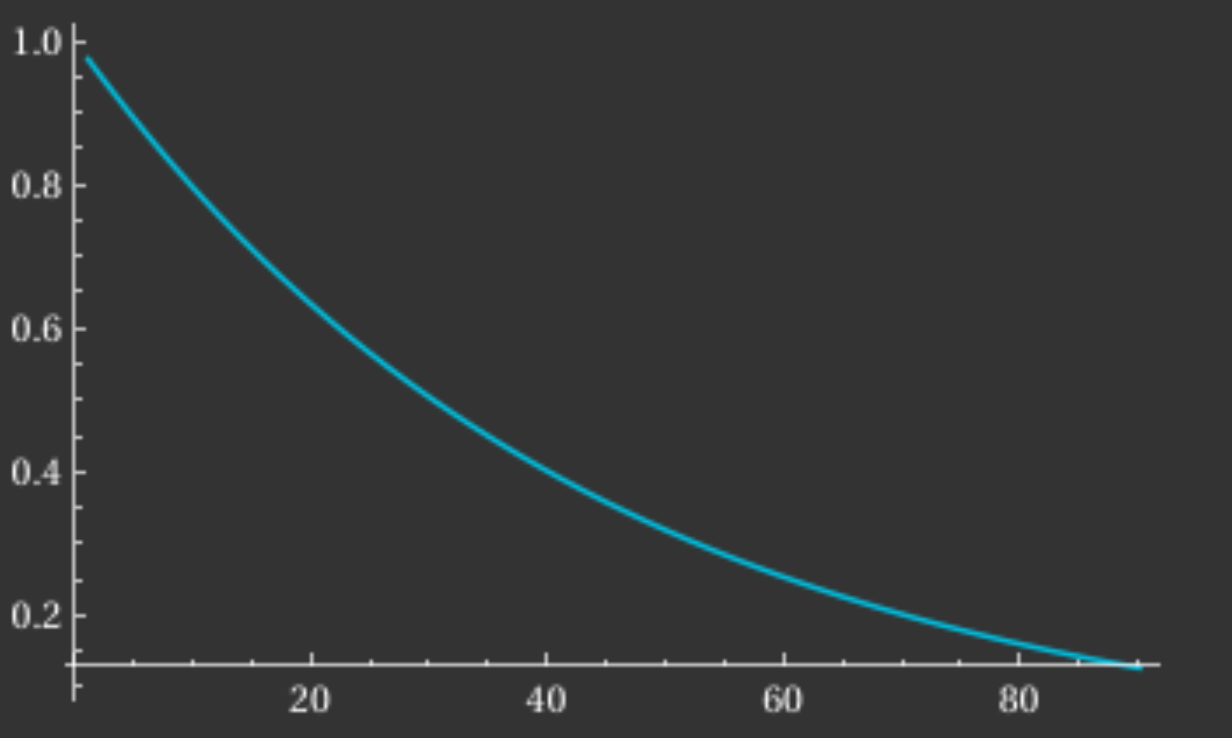
A single-game rating is a snapshot, so variation between games is normal. Your profile rating uses up to your 90 most recent rated games, with more recent games receiving greater weight. A representative mix of wins, losses, and close matches produces a more stable picture over time.
The Six Component Ratings
Version 3.2 introduced six new component ratings: Kitchen Game, Ball Control, Defense, Offense, Court IQ, and Targeting.
These ratings are built around related performance signals that better reflect how skills work together during a game. The goal is to make each rating easier to understand, more actionable, and better connected to the specific parts of your game that drive it.
We’ll add detailed drill-down charts for each component over time. As those pages grow, you’ll be able to explore the underlying stats and trends behind each rating.
Kitchen Game
Your Kitchen Game rating reflects how effectively you establish and sustain play around the kitchen zone. It considers your dinking, patience during kitchen rallies, positioning, movement through the transition zone, and coordination with your partner. Strong Kitchen Game performance means getting to the kitchen efficiently, maintaining good court position, and handling extended dink exchanges without unnecessary errors.
Planned drill-downs include dink rally length, transition-zone errors, kitchen arrival, partner spacing, and court coverage.
Ball Control
Your Ball Control rating reflects the quality and repeatability of your ball striking across different shot types. It considers how well you control speed, height, and overall shot quality, along with the responses your shots create. Serves and returns are important parts of Ball Control, but the rating also evaluates execution throughout the rally. Ball Control is not simply a measure of power. A controlled shot can be soft or hard. What matters is whether you consistently produce the intended ball and make the next shot difficult for your opponent.
Planned drill-downs include shot and response quality, contact height, speed, and height control across serves, returns, and rally shots.
Defense
Your Defense rating reflects how well you handle pressure, neutralize attacks, and work your way back into a rally. It considers your ability to reset attacking balls, defend speedups and overheads, recover after being pushed out of position, and turn defensive situations into neutral or offensive ones. Strong defense is not just keeping one more ball in play. It is taking away your opponent's advantage and creating an opportunity to regain control.
Planned drill-downs include reset effectiveness, overhead and speedup defense, recovery after being pushed back, defensive-to-offensive transitions, and the quality of the shots you hit while defending.
Offense
Your Offense rating reflects how effectively you create and capitalize on attacking opportunities. It considers when and how you speed up the ball, the pressure your attacks create, and whether those attacks force weak responses, move opponents out of position, or help finish the rally. Attacking more often does not automatically produce a higher rating if those attacks are poorly selected or easily countered.
Planned drill-downs include speedup timing and outcomes, attack selection and height discipline, pressure created, opponents pushed back, and how effectively you convert advantageous positions.
Court IQ
Your Court IQ rating reflects the quality of your decisions during a rally. It considers whether you choose the right shot for the situation, recognize when to attack or stay patient, keep unforced errors out of your game, and make sound decisions during important moments. Court IQ separates the ability to execute a shot from the judgment to use that shot at the right time.
Planned drill-downs include third-shot selection, attack decisions, error discipline, avoiding balls that are going out, and decision-making under pressure.
Targeting
Your Targeting rating reflects how effectively you place the ball with purpose. It considers depth, direction, court location, opponent position, and how well you vary your targets. Strong targeting can mean keeping a serve or return deep, finding an opponent's weaker side, using the middle effectively, placing the ball at a moving player's feet, or changing direction before your patterns become predictable.
Planned drill-downs include placement across serves, returns, dinks, and attacking shots, along with depth control, directional variety, opponent targeting, and predictability.
How the Previous Component Ratings Fit In
The performance signals behind the previous component ratings still matter within the new system:
Serve and Return contribute to Ball Control and Targeting.
Agility contributes to the movement, positioning, and transition elements of Kitchen Game.
Consistency is reflected through execution and error signals within each relevant component.
Offense and Defense retain their names but receive more focused definitions built around attacking pressure and defensive recovery.
♾️ Profile Rating
The rating shown on your Profile page uses up to 90 of your most recent rated doubles games, with more recent games receiving more weight.
🔍 Frequently Asked Questions
Why is my PB Vision rating different from my DUPR?
DUPR measures results — who won and by how much. PB Vision measures performance — how you played and what skills you demonstrated. Both use the same 2.0–8.0 scale, but they represent different things.
A gap between the two is normal and doesn't mean either is wrong. For example, you might play exceptionally well in a losing effort (high PB Vision, lower DUPR) or win a sloppy game against weaker opponents (lower PB Vision, higher DUPR). More representative games make your PB Vision profile rating more stable, but they do not necessarily make it match your DUPR rating.
Why are the ratings in my game so close together?
Pickleball games are often played between people of similar skill levels. That makes estimating the overall level of play easier than confidently separating small differences between individual players.
PB Vision first estimates the level of play in the game, then uses many performance signals beyond the score to determine how each player performed. This is why players on the winning team can sometimes receive lower ratings than players on the losing team.
When the data doesn't provide strong evidence that one player performed significantly better than another, the most accurate prediction may be only a very small difference. As a result, partners or opponents can sometimes receive very similar, or even identical, ratings for a game.
This doesn't mean PB Vision considers those players equally skilled overall. It means their performances in that particular game were too close to confidently distinguish.
Why can the winning team have lower PB Vision ratings?
PB Vision is not trying to recreate the scoreboard. It looks at how each player performed on the video: movement, positioning, shot quality, error rate, serve and return effectiveness, rally outcomes, and other signals.
A team can win because of partner dynamics, opponent errors, matchup advantages, or a few key points, while an individual player on the losing side may still show stronger movement and execution. Use a single-game rating as a snapshot. Your profile rating smooths this out by weighting your most recent tagged doubles games.
Why does my rating change between games?
Each per-game rating is a snapshot of how the model assessed your performance in that specific match, so it can vary more than your profile rating. For example, a strong game might rate 4.3 and a rougher game 3.5 even when your profile rating is 3.9. Swings of around 0.5 from your profile level can be normal, especially when you have a limited game history.
Your Profile Rating smooths out this variation by weighting up to 90 of your most recent rated doubles games, with more recent games receiving greater weight. For the most representative result, upload a mix of wins, losses, and close matches.
Why did my rating drop after reprocessing the same game?
Version 3.2 recalibrated the Overall Rating model to better predict playing level. Ratings were about 0.2 points lower on average in our test set, although the change for an individual game may be smaller or larger.
When you reprocess an older game, PB Vision evaluates it using the current model. The same footage can therefore receive a different rating. This does not mean your performance in that recording changed. It means the updated model is estimating your level differently. The goal is a more accurate and useful rating, not simply a higher or lower one.
Why can’t I see the previous categories on a new or reprocessed game?
Games analyzed with Version 3.2 calculate only the six new categories: Kitchen Game, Ball Control, Defense, Offense, Court IQ, and Targeting. The previous categories are not also calculated for individual games.
The new categories are built around more direct predictors of playing level and group related skills based on how they work together during a game. They also provide the foundation for upcoming drill-down charts that will show the underlying stats and trends driving each rating.
Why can the same video receive slightly different ratings when uploaded more than once?
Each upload is analyzed independently by multiple AI models, and estimates such as movement, speed, shot quality, errors, and player attribution are probabilistic. Small differences (typically ~0.1 rating points) can therefore occur even with identical footage, with somewhat more variation possible in short or one-sided games. No duplicate is inherently more authoritative, so keep one upload as the record and disregard the others rather than averaging them or selecting the highest rating.
Does PB Vision reward power or hard serves too much?
Patient and controlled play is also reflected through defensive performance, shot and return quality, rally outcomes, positioning, and error signals. If one game feels off, look at the underlying stats before judging only the overall number.
Why do ratings cap at 5.5?
The current 5.5 cap reflects the upper limit of what our model can confidently assess based on available training data. We're actively working on expanding the range.
Can my PB Vision rating give me a DUPR rating?
Yes, if you don't already have one. Link your PB Vision account to DUPR from your account settings, then submit a processed game to DUPR from that game's Overview tab. Your first PB Vision submission becomes your initial DUPR rating (shown as "AI-assisted"). If you already have a DUPR rating, your submission is recorded as data DUPR can use as the integration deepens, but it won't change your current DUPR number today. Each player must submit individually from their own linked account. More at pb.vision/get-rated.
What about abuse and users who game the system?
Player tags determine whose analysis is attached to a profile; they do not allow someone to choose a rating. For organized assessments, clubs should confirm player identities and manage tagging themselves.
Selectively uploading only strong games can bias a profile. For placement decisions, use structured sessions in which all games are recorded and uploaded. Roughly 10 representative games provide a stronger signal than one or two isolated performances. Unexpected ratings should still be reviewed alongside the underlying game data.
Version History
As our analysis improves, the AI may become more precise in how it evaluates different aspects of play. Because of that, ratings from analyses performed with different model versions may not always be directly comparable.
Version 3.2 August 14th, 2026
Introduced Kitchen Game, Ball Control, Defense, Offense, Court IQ, and Targeting
Recalibrated Overall Ratings to better predict playing level, lowering ratings by about 0.2 points on average in our test set
Replaced the previous per-game categories with components designed around more direct predictors of level and future drill-downs
Version 3.1 May 28th, 2026
Improved the precision of some skill predictors
Improved the model’s handling of uneven, overwhelming wins.
Version 3.0 March 12th, 2026
We’ve rolled out our third major update to PB Vision Skill Ratings! 🎉
Brand new auto-scoring that improves both the scoring and rating quality
New predictive features designed to capture more of a player's decision-making
Net 20% improvement in overall rating precision
🙏 Special Thanks
We wanted to extend a huge THANK YOU to Wei Pua. Wei was kind enough to provide player ratings on hundreds of videos that have helped to make our automatic ratings system happen.
Wei is a pickleball coach based in Kamloops, BC. Originally from Singapore, he now calls Canada his second home. Formerly an engineer, he’s passionate about how technology can enhance pickleball, and in particular he’s excited about PB Vision.

⁉️ Looking For More?
If you still have questions or run into issues, check out our Contact Us guide or email support@pb.vision.